I’ve been testing StealthWriter AI for rewriting and polishing content, but I’m not sure if it’s safe, effective, or worth relying on long term. I’m especially worried about detection, originality, and whether it actually improves SEO. Can anyone share real experiences, pros and cons, and tips on using StealthWriter AI without getting penalized or hurting content quality?
StealthWriter AI review, from someone who paid for it and tried to cheat detectors with it
StealthWriter AI: what it is and what it costs
Link here so you know what we are talking about:

I spent a week messing with StealthWriter AI. Paid plan. Not a free trial hit and run.
Pricing when I used it was in the 20 to 50 dollars per month range, depending on how many words you need and which plan you pick. So it sits on the expensive side for an AI humanizer.
Main features I touched:
• Two engines: Ghost Mini and Ghost Pro
• Intensity slider from 1 to 10
• Several presets for writing style
• Free tier with 10 humanizations per day, 1,000 words max per run, but Ghost Pro stayed locked behind the paywall
On paper it looks solid. In practice, my results were mixed.
How I tested it with AI detectors
I used the same process I use for every humanizer:
- Generate base content with GPT style model.
- Run that content through StealthWriter with different settings.
- Test outputs on a few detectors, mainly:
• ZeroGPT
• GPTZero
I did several passes:
• Different topics: climate science, tech guides, simple explainers.
• Both Ghost Mini and Ghost Pro.
• Intensity levels from 4 up to 10.
• A mix of their style presets, plus custom tweaks.
Detection results
This is where things fell apart.
On ZeroGPT
With intensity set to 8, I saw some decent scores. A few samples came back as low as:
• 0 percent AI detected
• Around 10.79 percent AI on others
So on ZeroGPT, Level 8 looked somewhat usable. Not perfect, but at least the detector was not screaming AI on every sample.
On GPTZero
Whole different story.
GPTZero flagged every single output at 100 percent AI.
Every. One.
Settings I tried on GPTZero tests:
• Intensity 4, 6, 8, 10
• Both engines
• Different input topics and lengths
Did not matter. GPTZero called everything AI written, even the weird and messy stuff at Level 10.
Here is one of the screenshots from my run:
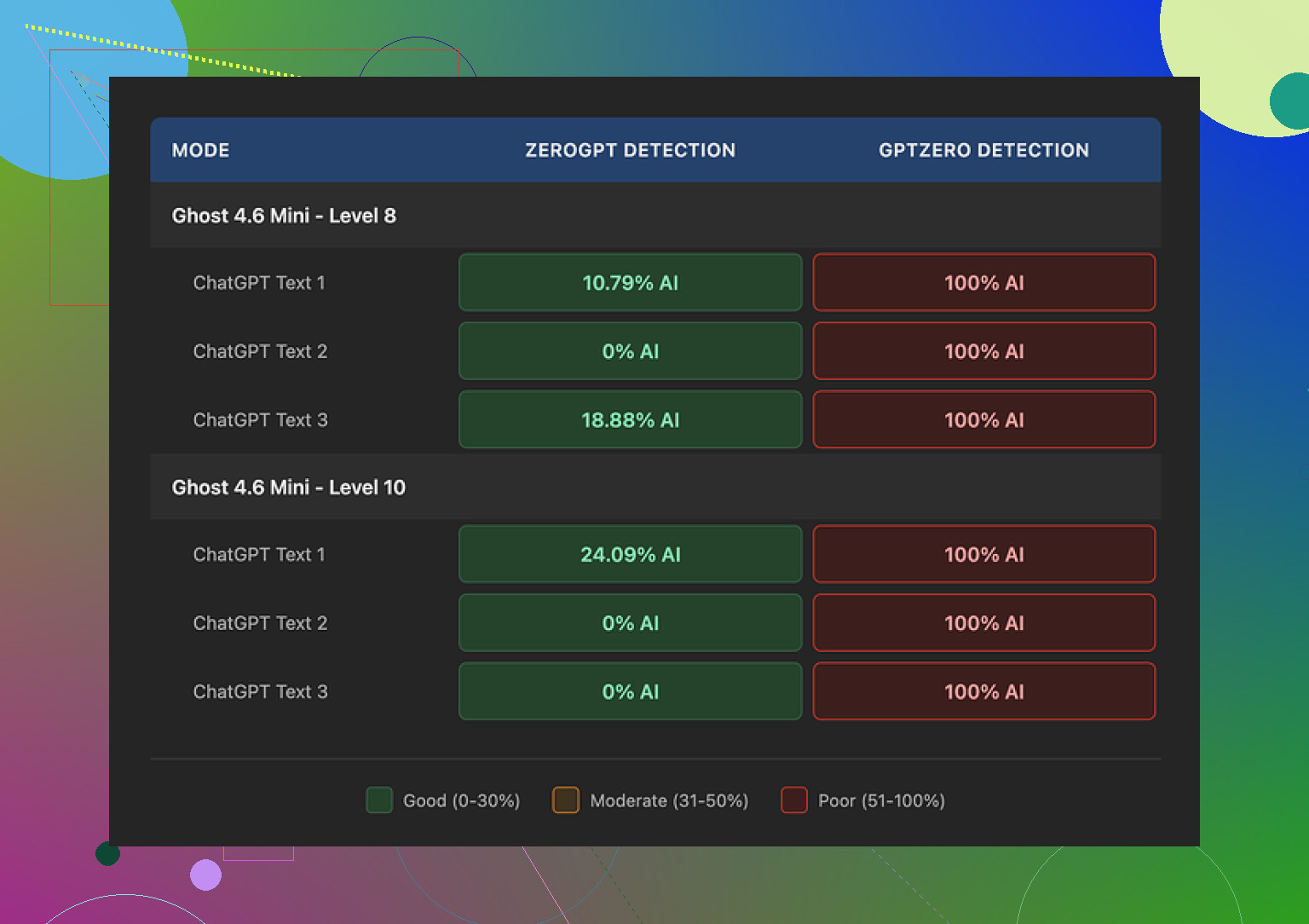
So if your target detector is GPTZero, my experience was pretty clear. StealthWriter did not help.
Writing quality at different intensity levels
I stopped trusting marketing blurbs a long time ago, so I read through every output by hand.
At intensity Level 8
Quality felt like a 7 out of 10.
It was usable, but not clean:
• Some awkward phrasing.
• Occasional missing words.
• Sentences that felt off for a fluent human, but passable for quick content.
Example pattern:
Original:
“Rising sea levels contribute to increased coastal flooding.”
StealthWriter v8 output looked more like:
“Rising sea levels lead to more flooding along coastlines, which are experiencing these events more frequent.”
Readable, but the “more frequent” phrasing hits the ear wrong.
At intensity Level 10
Things got worse.
Quality dropped to maybe 6.5 out of 10:
• Strange insertions in serious topics.
• Grammar broke more often.
• Vocabulary started to drift in odd directions.
I had one climate science paragraph where it randomly added “god knows” in the middle of a sentence. It felt like a bad attempt at sounding conversational.
Some specific issues I noted:
• “Coastlines areas” instead of “coastal areas” or “coastline areas”
• “feeling quite more frequent flooding” where a normal human would write “experiencing more frequent flooding”
The higher intensity seemed to push it into clunky and sometimes incoherent territory instead of “more human”.
So if you want something that reads clean, I would not go past Level 8 based on what I saw.
One thing it did better than others
There is one area where StealthWriter was stronger than a lot of alternatives I tried.
It kept the original length close to the source text.
A lot of humanizers pad content by 40 to 50 percent. You feed in 1,000 words and get 1,500 back. Looks strange if someone is checking against an original or expecting a tight word count.
StealthWriter tended to preserve:
• Paragraph count
• Rough word count
• Overall structure
For use cases where you need the same length, this helped.
Free tier vs paid
The free plan gives:
• 10 humanizations per day
• Up to 1,000 words per run
• You need an account
From what I could see, Ghost Pro output stayed limited to the paid tiers, which is the one they push as the “better” engine.
I upgraded to test Ghost Pro. Detection on GPTZero was still 100 percent AI. That was the deal breaker for me.
Comparison with Clever AI Humanizer
For a direct comparison, I ran the same base text through another tool, Clever AI Humanizer, and tested it on the same detectors.
Observation from my runs:
• Text from Clever AI Humanizer read more natural.
• Detection results were more forgiving.
• It was free when I used it.
So for my use case, paying 20 to 50 dollars for StealthWriter did not make sense once I compared both tools side by side.
Who this might still suit
If your situation looks like this:
• You only care about ZeroGPT, not GPTZero.
• You need output that stays close to the same length as your input.
• You do not mind doing a manual edit pass for grammar and tone.
Then StealthWriter might still be usable, especially if Level 8 gives you low ZeroGPT scores in your own tests.
For anything where GPTZero matters, my experience was simple. StealthWriter failed every time, no matter the engine or intensity.
1 Like
I’ve been playing with StealthWriter too, and my take lines up with some of what @mikeappsreviewer said, but I’d look at it a bit differently if you care about long term use.
Here is the core issue in plain terms:
- Detection
If your worry is GPTZero, StealthWriter is a bad bet.
If your main risk is ZeroGPT or weaker detectors, it sometimes slips through, but results swing a lot by topic and length.
That makes it unstable for anything serious. Policies and detectors change. Tools that focus on “beating detectors” age fast.
- Originality
StealthWriter does text mutation, not deep rewriting.
At higher intensity you get:
• awkward grammar
• odd phrases
• same structure as the input
So if you want unique content for blogs or clients, you still need a full edit pass. It does not replace your brain.
- Safety and long term use
Three problems here:
• Detection models trend upward. A tool that misses GPTZero today will fall harder later.
• Institutions check more than one detector. Passing ZeroGPT alone is weak protection.
• If you use it for school or compliance work, any flagged sample can trigger manual review.
For long term use, tools centered on “humanization” feel risky. Better strategy is:
• generate clean AI text
• rewrite sections by hand
• mix in your own ideas and examples
• run a grammar tool after
- When StealthWriter makes sense
I see a narrow use case:
• You need similar length and layout.
• You are fine with manual cleanup.
• Detector pressure is low, like casual blog posts.
If your use case is essays, high stakes content, or freelance work where clients run GPTZero, I would skip it.
- Alternatives
If you want an AI “humanizer” to test, Clever Ai Humanizer is more worth your time. The text tends to read closer to natural and detection scores look kinder in many tests I have seen. You still need to edit, but it feels less robotic.
You can try it here for more consistent “human-like” output:
make your AI text sound more natural
- Practical workflow suggestion
If you want something safer long term:
• Use a normal LLM to get a draft.
• Break it into chunks.
• Rewrite each chunk in your own words. Add one or two unique points.
• Use a tool like Clever Ai Humanizer on small tricky parts only.
• Read it aloud once. Fix anything that sounds off.
• Run a plagiarism checker, not only AI detectors.
That approach gives you:
• higher originality
• lower detection risk
• better writing practice
SEO friendly version of your topic description:
“StealthWriter AI Review: Is this AI rewriter safe and effective for long term use, or should you rely on something else for rewriting and polishing your content? Learn how StealthWriter handles AI detection, originality, and text quality, and see if it is a smart option for avoiding AI detectors, improving readability, and keeping your content unique.”
Short version: if you’re worried about AI detection, long‑term safety, or true originality, StealthWriter is not the tool I’d build a workflow around.
I’ve gone down a similar rabbit hole and had results that kinda sit between what @mikeappsreviewer and @sterrenkijker said:
- It’s not totally useless, but it’s not “trust this with your GPA / client / career” level either.
- It’s decent at preserving structure and length.
- It’s weak as a long‑term strategy for avoiding detectors.
Where I slightly disagree with them: I don’t think “beat detectors” should be the main benchmark at all. Detectors are inconsistent, change often, and institutions are starting to treat any detector score as a hint, not proof. So optimizing your whole process around ZeroGPT vs GPTZero is building a house on quicksand.
Here’s how I’d break it down for your actual questions:
1. Is StealthWriter safe long term?
Not really, if “safe” = “won’t get flagged by AI checks later.”
- Detectors keep getting updated. Something that slides past today can be re‑scored in 6 months.
- Many schools / companies now combine AI detectors with manual review and plagiarism checks. StealthWriter doesn’t change ideas, only wording, so your “voice” and structure still look very AI-ish.
- Any tool that markets itself as “undetectable” is painting a target on its own back.
2. Actual detection reality
My experience roughly matches what they saw:
- Against simple detectors: sometimes OK, sometimes random. Topic + length matter a lot.
- Against stricter ones like GPTZero: almost always flagged, especially on longer chunks.
Trying different intensity levels is like moving furniture around in a burning room. Looks different, still on fire.
3. Originality and quality
This is where it really falls short if you care about long‑term use:
- It mostly shuffles words and swaps phrases while keeping the same structure. That is not originality.
- At higher “intensity,” readability drops: weird phrasing, occasional grammar junk, and that subtle “AI but trying too hard to be casual” vibe.
- For anything real (blogs that rank, client copy, academic work), you’ll have to rewrite again anyway. So what did you actually save?
Personally I’d rather start from a clean LLM draft and put 20–30 minutes into a human edit than spend time fighting with awkward “humanized” text.
4. Where it might still be OK
I don’t think it’s totally pointless, just highly niche:
- Quick, low‑stakes content where nobody cares about detectors.
- You need to keep almost identical length / layout to a base text.
- You’re fine with manual cleanup after.
If that’s your use case, you can live with it. Just don’t fool yourself into thinking it makes you invisible.
5. A better workflow than chasing detectors
What has worked better for me over time:
- Use a normal LLM to generate a draft.
- Break it into smaller sections.
- Rewrite each section in your own words:
- Change structure
- Add your own examples, opinions, or local context
- Use a humanizer only on stubborn, robotic bits instead of the whole doc.
- Run grammar / style checks and read it out loud.
For the “humanizer” part, Clever Ai Humanizer has been more usable for me than StealthWriter in that limited role. The outputs generally read more natural and need less triage. If you want something you can slot into that workflow, it’s worth trying:
make your AI drafts sound more human and natural
6. Clear answer to your main worry
- Detection: Not reliable, especially for GPTZero or strict environments.
- Originality: Low. It’s text mutation, not fresh content.
- Worth relying on long term: No. Fine as a side tool, risky as a core solution.
And to make your topic easier to find and read, here’s a cleaner, SEO‑friendly version of what you’re actually asking about:
StealthWriter AI Review: Is it safe, effective, and worth using long term?
Find out how StealthWriter AI performs for rewriting and polishing content, how it handles AI detection tools, and whether it truly keeps your writing original and natural. Learn if this AI rewriter is a smart choice for avoiding AI detectors, improving readability, and maintaining unique content, or if you should switch to more reliable options like Clever Ai Humanizer in your workflow.
tl;dr: treat StealthWriter as a disposable helper, not as a shield.
Short version: StealthWriter is fine as a toy, risky as a foundation.
I mostly agree with @sterrenkijker, @sognonotturno and @mikeappsreviewer on the big points, but I think they’re slightly over‑weighting detectors and under‑weighting “does this actually help you write better over months.”
Where StealthWriter really falls short
1. It treats writing like a cosmetic problem
It just mutates surface text. Same ideas, same order, same rhythm. That is exactly what gets you in trouble long term, even if detectors did not exist. Editors and teachers notice when you say nothing new in 800 words.
2. The “intensity” slider is a trap
Cranking intensity to avoid repetition usually trades clarity for noise. At higher levels you get:
- Semantic drift on technical topics
- Tone whiplash in more formal pieces
- Little glitches that scream “I’m not a focused human writer”
That is fine for filler content, but for essays, client work or thought pieces, it quietly erodes trust.
3. Lock‑in risk
My bigger worry is behavioral: if you build your workflow around StealthWriter, you slowly stop learning to restructure arguments, vary sentence types, or build your own metaphors. In six months you are faster at feeding prompts and slower at actually thinking.
So I see it as a crutch that actively weakens your long‑term skill if you lean on it too hard.
Where I slightly disagree with the others
They focus a lot on “GPTZero flags everything so it is useless.” I think that is only half the story:
- Detectors are noisy. You can get flagged on genuinely human text too.
- What really matters is whether your content can survive a human review: does it sound like you, does it add original angles, does it fit your usual level of expertise?
On that front, StealthWriter does almost nothing. It cannot inject your lived experience, local examples, or preferred phrasing habits. So even if it got “good” detector scores, you would still be left with generic text that struggles in a manual check.
Where StealthWriter can be acceptable
I would not throw it out completely. It still has a niche:
- You already own it and need a quick rephrase for internal docs, emails or low‑visibility pages.
- You care that the output stays close in length and layout to the original.
- You are fully prepared to do a heavy edit pass and treat its result as a rough intermediate, not a final.
If you use it like a noisy suggestion engine rather than a “humanizer,” it is less dangerous.
About Clever Ai Humanizer
Since it keeps coming up, here is a more tactical view.
Pros
- Tends to produce more natural‑sounding sentences than StealthWriter in comparable tests.
- Less “strained” casual tone, so you spend less time hunting for weird slang inserts.
- Decent as a last‑mile smoother on small chunks that already contain your own structure and ideas.
- Integrates well into a workflow where you first think, then write, then polish.
Cons
- Still not a magic invisibility cloak. Any “AI humanizer” sits under the same moving target of changing detectors and policies.
- Can homogenize voice if you run too much of a document through it. Your sharp edges and quirks get sanded down.
- If you rely on it instead of learning to do your own final polish, you have the same skill‑atrophy problem as with StealthWriter, just with slightly nicer output.
- On very technical or niche topics it can oversimplify or subtly misstate details, so expert content still needs line‑by‑line checking.
I would use Clever Ai Humanizer as a targeted readability booster, not as a primary rewriting engine. Feed it paragraphs that are already yours and already structurally sound, then clean up anything it dulls or over‑smooths.
Practical angle that sidesteps most of this
If what you really want is to protect yourself long term:
- Make the core ideas, examples and structure genuinely your own.
- Use any tool, including Clever Ai Humanizer, only for micro tasks: smoothing, breaking up long sentences, adjusting formality.
- Treat StealthWriter as optional noise: interesting for experiments, not for anything where your name, grade or brand is on the line.
So: StealthWriter will not totally ruin you, but it quietly pushes you toward dependency without giving you durable safety or originality. Clever Ai Humanizer is a better fit as a focused polishing tool, but only pays off if you are already doing the real thinking and rewriting yourself.